


What We Keep

We live in a world that manufactures products by the millions. Yet the things we keep for decades are almost never the expensive things. They’re the ordinary objects that became witnesses to our lives.
I was a teenager the first time I understood this, though I didn’t have words for it yet. I was walking the shoreline in Petoskey, Michigan — my hometown, the place that gave its name to the stone I was about to find without knowing what I was looking for. The water was cold. The stones were everywhere, gray and unremarkable until you wet them, until the light hit them right and the pattern surfaced: hundreds of small hexagonal cells, each one a coral creature that lived and died 350 million years ago.
I picked one up. I don’t remember deciding to keep it. I just never put it back down.
That stone survived glaciers. It survived being ground against a million other stones, tumbled by water and time until whatever sharp edges it once had were gone. What was left was pattern — the fossilized record of something that had been alive, compressed into rock, polished by forces that had nothing to do with gentleness and everything to do with endurance.
I still have it. Decades later, it’s still in a drawer I know exactly how to find in the dark.
I think about that stone differently now than I did at fifteen. Back then it was just a pretty rock, a good souvenir. Now I understand it as something closer to a metaphor I didn’t ask for — because the way that stone holds its history is not so different from the way we hold ours.
Some of what shaped us is visible. We can point to it, tell the story, trace the pattern like a fossil in rock. But some of it isn’t visible at all, not because it wasn’t real, but because trauma doesn’t always leave a legible pattern. Sometimes it just leaves smoothness where an edge used to be, or an edge that’s still jagged. Sometimes the record is there, but the story that goes with it isn’t — not because we’ve forgotten carelessly, but because some part of us decided, a long time ago, that forgetting was how we’d survive it.
We are, all of us, walking around holding stones we can’t fully read. Ancient. Shaped by pressure we didn’t choose. Carrying patterns that mean something, even when we can’t name what.
I don’t think the goal is to force every stone to give up its story. Some of it isn’t ours to excavate on command, and some of it may never come back at all. But I think there’s something worth doing in picking the stone up anyway. In not putting it back down. In saying: this is mine, whatever it is, however it got this way. I’ll keep it.
That’s most of what I’ve learned about memory, and about myself, at sixty.
It’s also why I make what I make.
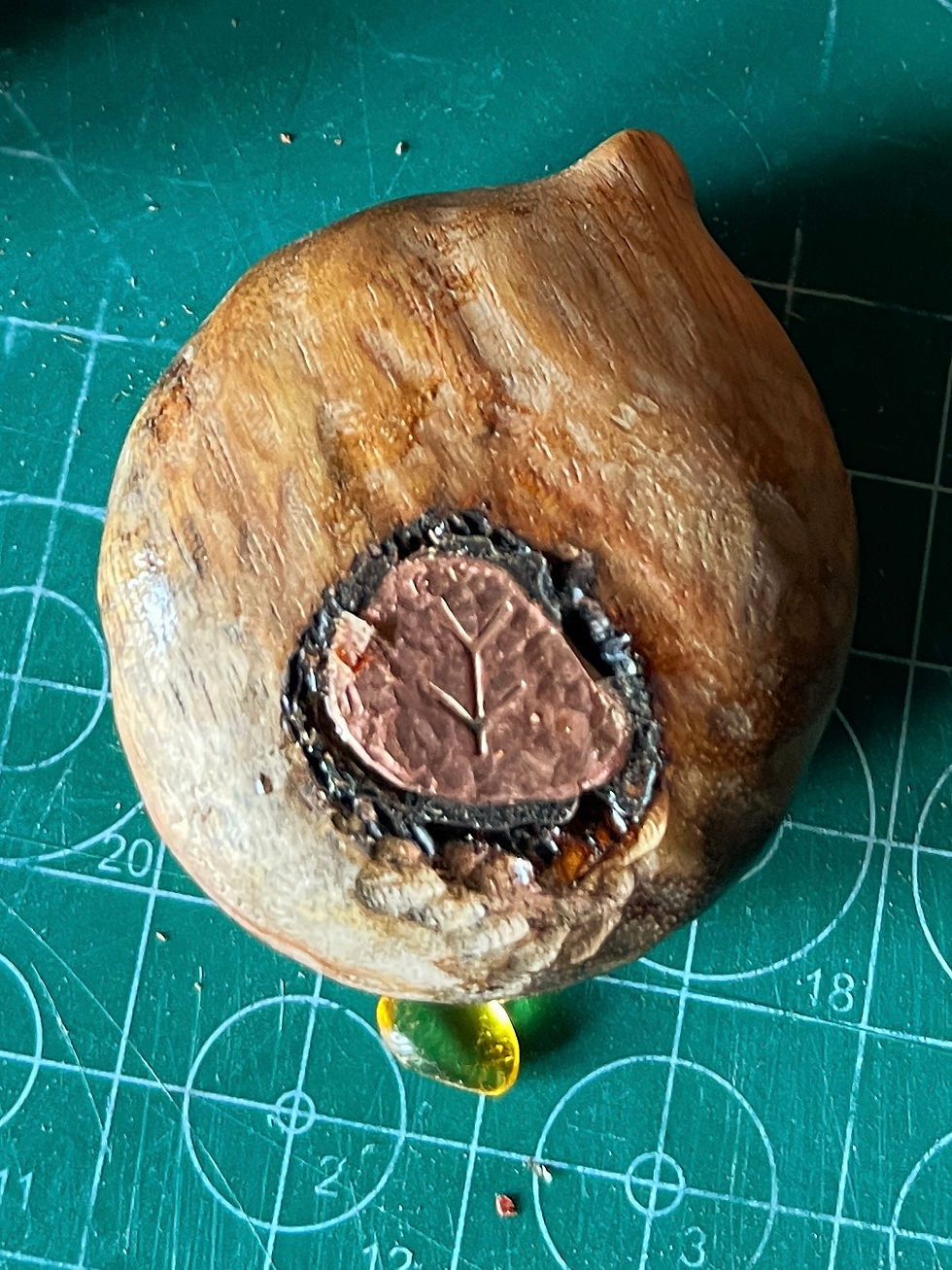
Every signal token I cast, carve, or burn by hand starts from that same instinct — the one that bent down on a Petoskey shoreline before I had language for it. These aren’t merchandise. They’re not decoration. They’re built to do what that stone did without trying: to hold a pattern, to survive the tumbling, to still be legible decades later when you finally know how to read it.
Because a lot of us were handed a different story a long time ago. One that wasn’t ours, told by people who benefited from us believing it — that we weren’t enough, weren’t strong enough, weren’t built to lead, weren’t built to stand at the center of our own lives. That story got worn into us the way water wears a shoreline, patient and constant, until we stopped noticing it was even happening.
But underneath that story was always another pattern. Older. Truer. Ours.
Older than the stories that shrank us, there were women who carried whole families across winters they weren’t supposed to survive. Women who ran households, farms, tribes, kitchens, battles — long before anyone was writing down whether they were allowed to. Women who healed, who buried, who fought, who built, who knew exactly what they were capable of because there was no one else around to do it instead. That knowledge didn’t come from permission. It came from necessity, and it got passed down anyway — in the way a mother’s hands move, in the set of a jaw, in a stubbornness that skips a generation and then reappears exactly when it’s needed.
That’s the pattern underneath the pattern. Not a new strength we’re inventing for ourselves now, but an old one, fossilized, waiting under the polish — the same way that hexagonal coral pattern was in the stone the whole time, whether or not the water had worn it smooth enough yet to see.
I don’t make what I make to remind us of something new. I make them to remember what was already ours before systems told us otherwise. Our strength, our power, our grace, our ability to endure what should have broken us and still rise to carry the next generation — none of it was ever missing. It was only buried, the way a stone sits under moving water until the current finally wears enough away to show what was there the whole time.
That’s the whole of it. We do not ask for what is already ours.
We remember.


Comments